

How To Spot and Avoid Author Scams

Written by Leslie Cox
The ability to spot fake offers from bad actors intent on stealing an author’s time, money, and energy is a necessary business skill. Scammers promise publication deals, pretend to be a high-profile agent or editor, offer a spot at a coveted, competitive book festival, or claim to have an inside track to get your book in the hands of a massive book club. Unfortunately, AI has made a scammer’s life easier while making it harder for hopeful authors to spot the lie. Read on for information to protect yourself, links to additional fraud-prevention resources, and the honest experiences of some Arizona authors who were targeted by scammers.
Writing: An Emotional Journey
Writers, as we know, work tirelessly—sometimes for years—to complete a work of art whether it’s fiction, non-fiction, or poetry. We spend a good amount of time, energy, and resources on education including workshops, conferences, and sometimes degrees. We research, travel, draft, and edit. If our end goal is traditional publication, we pitch tirelessly in the hopes of attracting a dream agent or a publisher. If we decide to self-publish, we travel the same route but also have to learn about manuscript formatting, distribution, and marketing.
Once we have typed, The End, we often imagine instant gratification and recognition. We picture ourselves walking into a bookstore to see our name illuminated on a beautiful book cover propped on the table of New Releases.
Scammers Prey on Hopes and Dreams
What we don’t picture is that scammers are waiting in the shadows. They see our desire to be published, our desperation to realize our dreams, and they know we’re vulnerable. Unfortunately, our earlier noted desire and all of the time, energy, and money we’ve spent to get to whatever point we’re at can make authors easy targets. Writer scams are multiplying—and becoming more creative, mainly due to the constantly expanding use of technology, especially AI.
Scammers Promise Quick Wins and Big Payoffs
Scammers claim to be literary agents, publishers, famous authors, network program buyers, celebrities, and more.
Most scams can be boiled down to the same promise, wrapped in different packaging: Hey author, I can make your publishing journey easy. Examples of the packaging scammers use:
“Your book will be an instant success!”
“Your book will be a bestseller within 30 days!”
“Enormous advances are in your future!”
“We will help you get paid podcast interviews and book-to-film deals.”
“We’ll get your book in the hands of our huge bookclub!”
Yada yada yada.
If you remember one thing, please let it be this: a legitimate agent or publisher does not offer promises or guarantees. There are no guarantees in the publishing industry. Absolutely none.
How Do Scammers Pick Their Targets?
Fraudsters often prey on authors who have little to no experience in publishing. This means debut authors on both the traditional and self-publishing path get hit hard. Scammers claim to have inside knowledge of how the business works. It’s a tempting lure: publishing is a complicated and complex business. The path to publication can feel very gray. Any type of offer to make the road less bumpy, to speed up the journey, is likely to at least get opened by an author.
Scammers find targets in all kinds of ways. They might see our posts in author/publishing chat rooms and online. They might research your website and add your email address to their lists. Or they may search the internet for keywords around author and pull you into their funnel. If you’ve been targeted, try not to take it personally. Scamming is a business. A big one. Which means it’s a numbers game.
It’s Easy To Say You’d Never Fall for A Scam
Perpetrators who target authors are getting savvier. With AI at their disposal, it’s easier than ever to personalize an outreach email or message to make themselves sound credible. Most scammers really do sound like they’ve read your work. Not only read it, but deeply connected with your words/story in a way that others haven’t. In a way that lights you up and makes you feel appreciated and validated. In a way that makes you feel seen. The safest way to protect yourself is to always do your research before choosing to work with a person, service, or business. Especially those who reach out to you out of the blue.
Learn to Spot A Scam
All scammers work differently, but there are consistent elements you can look for, like the ones listed below. The more of these elements you see grouped together in outreach to you, the more you should ignore the offer sent your way because it’s likely a fraudster.
Unexpected Outreach: Reputable literary agents, major publishers, and producers rarely contact authors out of the blue. If someone claiming to be one of these people does reach out to you and it seems too good to be true, it likely is. It’s more likely that the person who reached out to you is impersonating a reputable agent or publishing house and isn’t connected to them.
Up-Front Fees: Literary agents and publishers will never charge you an upfront fee or try to sell you services. Agents work on submission which means they only earn money if they sell your book to a publisher. Typically, they earn 15% of advances and royalties, which are never paid directly out of an author’s pocket.
Suspect Email Address: Most established publishing professionals do not use a Gmail or an Outlook email address. Although the email address may look authentic, always check the company’s website for validation. Minor differences in spelling can be missed.
Sloppy Spelling and Terminology: An authentic literary agent does not use the term “traditional publisher” because it’s a given those are publishers they engage with. Other red flags to watch for: poor grammar, incomplete sentences, misspelled words, changing fonts that suggest copy/paste, or details that don’t add up. Some fraudsters pretend to be following up on a previous conversation with you (that never happened).
How To Protect Yourself From Scams
Education and diligence are your best friends against scammers.
Be prepared to recognize bad actors. If an offer seems too good to be true, it probably is.
Educate yourself about the industry. Have a clear understanding about contracts, rights and finances, and how the publishing process works end-to-end.
Verify the identity and credentials of those who may be impersonating an agent, famous author, etc. via their website. Send an alert through official channels to them saying you received a fraudulent email from someone pretending to be them and attach a copy of the email.
Don’t respond or engage. Flag email, text messages, and social media outreach as spam/junk and report them where possible.
If you choose to engage in hopes the offer is legitimate, ask for references and testimonials. Interview authors who have used that agent or publisher. Suggest switching communications to a different platform, or demand a video call; scammers will always say no.
And, finally, never succumb to pressure.
A Note About Hybrid Publishing
Hybrid Publishing is an author-subsidized publishing model where the author pays for various elements of production, printing, and warehousing, and the parties share risks and earnings. Hybrid publishing isn’t a scam. It has received a bad rap because of vanity presses that call themselves “publishers.” Vanity presses have no real strategy for vetting, marketing, distribution, or sales. However, many authors have found successful partnerships with legitimate hybrids. The Independent Book Publishers Association has posted established criteria for hybrid publishers which are standards the publisher is expected to meet as a measurement of integrity. If you decide to work with a hybrid publisher, do your research.
The FBI: Working to Protect Authors From Scams
A private sector of the FBI is now involved in publishing scams. The FBI notes these scams are difficult to prosecute.
FBI tips for authors
Research yourself online to see what personal information is available to scammers. IE: Type in “Your Name, Author” and see what comes up in a search. Is there information someone could use to target you with a scam?
Never click links, call phone numbers given, or provide personal information to people you don’t know. Some perpetrators impersonate FBI agents or law enforcement officers.
If you feel threatened, file a police report and file a complaint, with specific information, at www.ic3.gov.
True, Recent Examples From Friends
Wanda: Reviews, Marketing, and Book Club Promo
Wanda received an email from Mary Brown (domain: gmail.com), saying she came across Wanda’s novel while browsing Amazon. It’s a bit creepy when she elaborates:
“your cover carries the peaceful, reflective quality of a woman pausing to listen to her own heart. What truly held my attention was learning more about you, how you wrote a tribute song for the youngest victim of the Tucson shootings and your poem sits at the Oklahoma City National Memorial.”
Mary believes Wanda’s book series was built for book clubs and is waiting for its first circle of readers to gather. Then comes the most disturbing part: Mary says she has noticed a single rating—a glowing five-star review, vouching for the book. “What the book needs is a few more thoughtful, genuine voices to turn that single review into the beginning of a conversation.”
The scammer goes on for several paragraphs, offering advice about category placement for the book and offering a book discussion tour, which will lead to more reviews, and ultimately more sales. All Wanda needs to do is reply with ‘I am interested’ or ‘Send more details’ and Mary promises to walk her through every step personally.
Wanda later received a similar email from Matilda Kelly (domain: gmail.com), appealing to the author’s emotions:
“This feels scary to send, but I’m trusting my heart today. I’ve started this message so many times and deleted it, because nothing I write feels big enough. But I need to try. Your words found me at a time when I was quietly falling apart. I wasn’t sleeping, I was carrying so much heaviness I couldn’t even explain it to the people closest to me.”
Waahh! She continues for several paragraphs that closely resemble Mary’s email., ending with, “Just reply with ‘interested.’ I will send a detailed, no-pressure breakdown of the exact steps and what to expect. No sales call, just clear thoughts from someone who truly sees the heart in your storytelling.”
Right—no pressure…
Wanda received yet another email offer, this time from Amanda Frankel with Books, Brews & Beverages for Busy Book Lovers—a Meetup group, offering to feature her book in their book club.
Now that sounds like fun!
Not.
Wanda did some research. After five to six emails back and forth, Amanda Frankel requested money. “We’ll get more specific about the offer once you lock in and send your $200.” Wanda didn’t send money.
Susan: Book Clubs, Agent Representation, Author Impersonation
Susan, over the past year, has received countless scam emails, praising her literary talent and promising fame. Those emails have become more sophisticated over time.
“Usually, it starts with a letter claiming to have read one of my books. It is filled with effusive language about how the book is changing lives or how their book club is dying to have a virtual visit with me. There is often a photograph at the signature which they have copied off a real photo from a Meetup group.”
When Susan Googles the group, it looks convincing. She knows it’s fake, mostly because she gets the same message from various email addresses. Some offer to option her book (for a price, of course) and plan speaking events (for a fee). A so-called “agent” requested payment for representation, and another messaged her, impersonating a “renowned author.” Susan alerted the author via her website and learned many others had alerted her as well.
Derek: Netflix Adaptation
Derek received an email from Netflix Global Entertainment, Subject Line: “Lights, Camera, Collaboration: Your Book’s Journey to Netflix!”
Well, that sounds exciting.
But the email was from an impersonator named Maria Ferreras.
“Your book has truly captured our attention with its insightful narrative and invaluable wisdom. We believe it holds tremendous potential for adaptation into visual media, and we are eager to explore the possibility of bringing your extraordinary story to the screen.”
The language, in several paragraphs that follow, sounds authentic and offers a comprehensive overview detailing their proposal.
“Should you be interested in showcasing your book to our creative and marketing teams, please let us know a convenient time for you to schedule a meeting or call. We are keen to hear your vision for the adaptation and explore how we can work together to bring your story to life on screen.”
Its header looks very similar to the Netflix logo, and Maria provided a photo of herself (yeah right….), along with an enticing range of compensation offers for adapting the book into a movie, screenplay development, a production bonus, and royalties.
What a deal!
Derek didn’t buy it. Instead, he pulled a fast one on his scammer by providing a YouTube link to the Rick Roll video Never Gonna Give You Up!
PHX Oasis Press: Book Club
Phoenix Oasis Press received a fraudulent email from “Safia,” the organizer for Westside Women’s Book Club in LA, referencing our recent anthology, The Weight of Almost Knowing. Safia said what caught her eye was “the theme of ‘curiosity’ and the specific focus on Arizona voices.”
Sounds legit, right? Then came the offer to showcase the collection to their community of over 1,000 active readers,
“If you’re interested, let me know and I can send over the details on how we feature our picks and what we’d need from your side to get it set up.”
We did not respond.
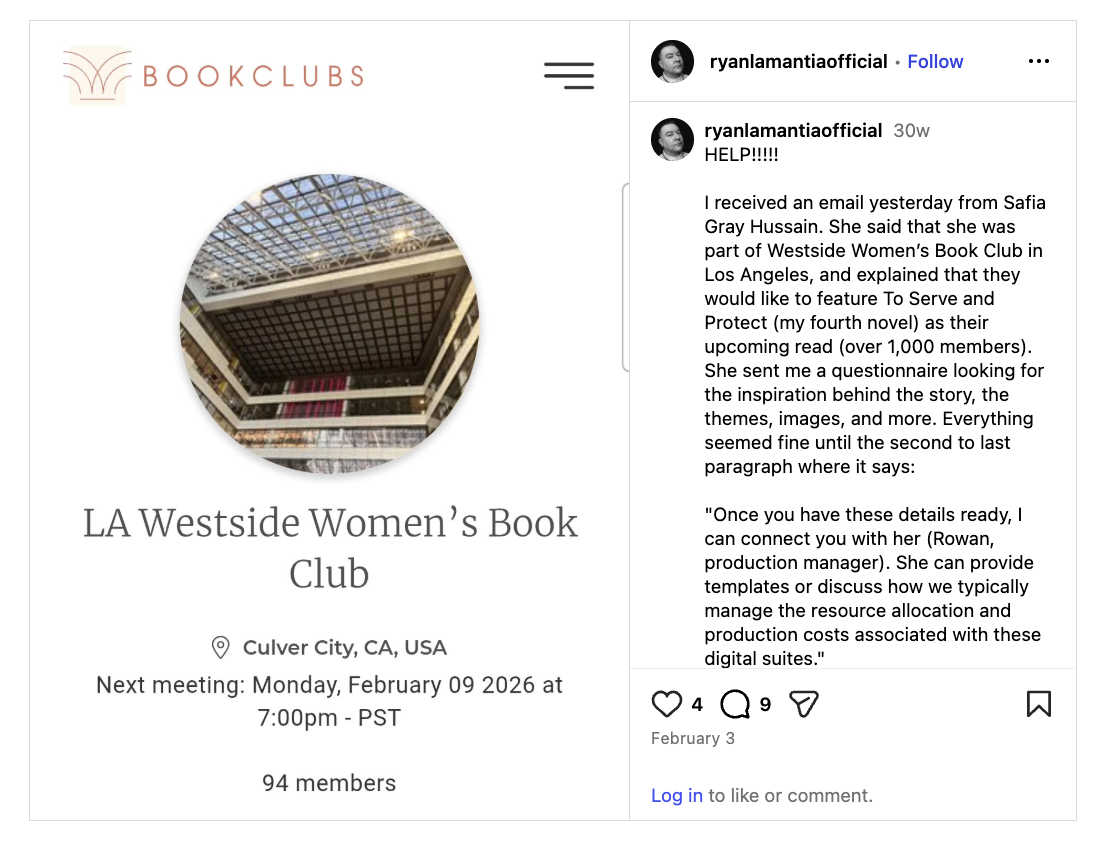
We’re not the only one Safia hit.
Colorado author Ryan LaMantia posted about his experience with the Westside scam. He notes how, near the end of their chats, Safia spoke about ‘managing the resource allocation and production costs.’ A clear indication he would have to fork out money.
John: Publisher Outreach
John is a fiction author who had lightly stepped into the world of querying. He had written his book, had family help with the query letter, and sent it to a trusted friend for feedback. Suddenly, he got an email from a publisher. His first thought was that the friend had a connection with the publisher and had reached out to them on his behalf. Alas, the friend hadn’t. John knew no one really knew about his book, not in a way that a valid publisher would have stumbled across his manuscript. He took a hard look at the offer sent his way. It was vague, overpromising, and hinted at costs. He sent it to his spam folder without a second thought.
Samantha: Event Space
Samantha applied to a high-profile Arizona book festival, a great place for visibility, sales, and networking. Someone reached out to get payment for her table via a payment link. After paying, communications with the festival went quiet. When Samantha checked in with the festival, it turned out they hadn’t made decisions yet. The scammer was long gone, and Samantha hit dead ends trying to track them down.
Resources to Help Authors Bust Scams
If you’re an author and publication is your goal, it’s highly likely you’ll be hit by a scam at some point on your journey. Don’t let the bad actors ruin your experience. Do your research, and arm yourself. These sites / resources can help:
Writer Beware® Blog - Shines a bright light into the dark corners of the shadow-world of literary scams, schemes, and pitfalls. Also providing advice for writers, industry news, and commentary. Writer Beware is sponsored by the Science Fiction and Fantasy Writers Association. The Writer Beware blog includes more than 15 years of content, all of it searchable. You can also sign up for email updates.
The Authors Guild - Supporting working writers and protecting authors’ rights since 1912. The Authors Guild advocates for supporting free dspeech, fair contracts, and copyright. They have a great post about avoiding publishing scams.
Jane Friedman - Jane Friedman has spent her entire career working in the publishing industry, with a focus on business reporting and author education. Filled with free resources and a refreshingly candid take on the industry, her website is a must-visit for authors. She also offers a recommended resources list worth reviewing. Do a search on-site for scams and you’ll find plenty worth reading.
Keep Moving Forward, Author
You’ve worked hard on your story. Be proud of your work and your effort. There will always be scammers out there. Don’t let them stop you from moving toward your dreams. Just be vigilant, and realistic. We all know that there are no shortcuts to publication. As they say in A League of Our Own, “It’s supposed to be hard. If it wasn’t hard, everyone would do it. The hard is what makes it great.”
ABOUT LESLIE COX
ARIZONA AUTHOR LESLIE COX WRITES PERSONAL ESSAY AND MEMOIR. A KEY MEMBER OF PHX OASIS PRESS, LESLIE CAN BE FOUND REPRESENTING POP AT AREA EVENTS, AND HELPING OUT AT OUR RECURRING NETWORKING EVENT. A RETIRED HEALTH-CARE EXEC, LESLIE IS IN QUERYING STAGES WITH HER MEMOIR AND IS RESEARCHING A WORK OF FICTION ABOUT HER FAMILY’S HISTORY. FIND HER ONLINE AT LESLIESVOICE.COM.